Google Cloud vs MongoDB
Choosing between Google Cloud and MongoDB can be tough. One is a massive cloud infrastructure provider, while the other is a specialized data platform. Here's how to decide which one fits your project.
Leistungsstarke Infrastruktur, riskante Abrechnung und Support.
Wir erkennen an, dass Google Cloud eine führende Infrastruktur liefert, die eine leistungsstarke KI-Integration und erhebliche Skalierungsmöglichkeiten für Workloads von Unternehmen bietet. Die hohe Anzahl von Berichten über unzugänglichen Kundensupport und verwirrende, intransparente Abrechnungen ist jedoch zutiefst beunruhigend. Insgesamt betrachten wir diese Plattform als hohes Risiko für Nutzer, die Wert auf reaktionsschnelle Hilfe oder eine granulare Kostenkontrolle legen.
Vorteile
- Zugang zu erstklassigen generativen KI-Tools wie Gemini und Vertex AI.
- Unterstützt Open-Source-, Multicloud- und Hybrid-Entwicklungsstrategien.
- Neue Benutzer erhalten bei der Anmeldung 300 $ an kostenlosen Credits.
- Bietet potenzielle Einsparungen von bis zu 57 % durch Rabatte für feste Nutzung.
Nachteile
- Der Kundenservice-Support ist oft unzugänglich und versteckt.
- Nutzer berichten von intransparenter Abrechnung und unerwarteten Gebühren trotz vorhandener Guthaben.
- Extrem hohe Kosten für technische Support-Abonnements (bis zu 12.500 $/Monat).
- Das Fehlen harter Ausgabenlimits für Pay-as-you-go-Dienste ist ein häufiger Kritikpunkt.
Powerful, flexible platform for modern data.
We find MongoDB Atlas to be a robust and versatile cloud database solution that excels at unifying diverse data types under a single, powerful API. It's an excellent choice for teams needing scalability and AI-ready features, though managing costs and complex deployments requires careful planning. Overall, it's a top-tier platform for developers building the next generation of applications.
Vorteile
- Excellent flexibility with its document model.
- Powerful, unified platform for databases, search, and streaming.
- Strong scalability and high availability guarantees.
- Native vector search integration for AI applications.
Nachteile
- Costs can escalate quickly with high usage and dedicated resources.
- Advanced features and configurations can have a steep learning curve.
- Support responsiveness can be inconsistent for some users.
ÜberGoogle Cloud
Google Cloud ist eine umfassende Cloud-Plattform mit über 150 Produkten und Funktionen. Sie hilft Unternehmen, bestehende Infrastrukturen zu modernisieren oder komplett neue KI-gesteuerte Anwendungen aufzubauen. Der Dienst ist für Entwickler, Unternehmensleiter und Start-ups konzipiert, die digital wachsen und sich transformieren möchten.
Neue Kunden können Google Cloud mit der kostenlosen Nutzung von über 20 Produkten testen. Darüber hinaus erhalten Sie bei der Anmeldung 300 $ in kostenlosen Credits, um die Erkundung zu erleichtern. 💡
ÜberMongoDB
💡 MongoDB Atlas is a comprehensive cloud data platform built for modern applications. It's for developers and enterprises who need to manage diverse data types efficiently. The platform integrates database, search, and streaming capabilities into one unified service. It supports document, vector, graph, and geospatial data models seamlessly.
Highlights
Funktionsvergleich
Funktionsübersicht
Wir heben die Hauptunterschiede hervor und wählen einen Gewinner für jede Funktion.
Core Purpose
Google Cloud is a vast cloud infrastructure platform. MongoDB is a specialized data platform.
Google Cloud offers over 150 products. You can run everything from VMs to AI models. It's like renting a supercomputer. MongoDB Atlas focuses on your data layer. It manages your database, search, and streams. It's like having a dedicated, expert DBA. The difference is scope vs. specialization. Google Cloud provides the entire toolbox. MongoDB excels at one critical tool. For a startup building a full app, Google Cloud provides the foundation. For a team optimizing a data-heavy feature, MongoDB is targeted.
AI & Data Analytics
Google Cloud has massive AI/ML and analytics suites. MongoDB has native vector search for AI apps.
Google Cloud's Vertex AI and BigQuery are industry leaders. You can build models with 200+ foundation models. BigQuery runs petabyte-scale analytics. MongoDB's strength is unifying data and vectors. You can store operational data and embeddings together. This simplifies building AI features like semantic search. Google Cloud offers a broader, more complex AI platform. MongoDB makes specific AI workflows simpler. One is a comprehensive lab, the other a focused workbench. Choose Google Cloud for custom model training. Choose MongoDB for integrating AI into your existing app's data flow.
Database Flexibility
Google Cloud offers multiple managed databases. MongoDB offers one highly flexible document database.
Google Cloud provides Cloud SQL, Spanner, Firestore, and more. You pick the right tool for each job. This can mean managing multiple systems. MongoDB uses a single document model for all data. The same API handles operational, graph, and geospatial data. This reduces context switching. Google Cloud gives you specialized databases. MongoDB gives you one versatile database. It's the difference between a Swiss Army knife and a full workshop. For apps with diverse data types in one service, MongoDB is seamless. For needing different database engines, Google Cloud has options.
Real-time Processing
Google Cloud uses multiple services for streams. MongoDB has integrated stream processing.
Google Cloud handles streams with Dataflow, Pub/Sub, and others. It's powerful but requires configuring separate services. This adds architectural complexity. MongoDB Atlas Stream Processing is built in. You use the same query language for streams and batches. This creates a unified developer experience. Google Cloud offers more scalable, global streaming. MongoDB offers simplicity and integration. One is built for massive scale, the other for developer velocity. For processing Kafka streams alongside your app data, MongoDB is simpler. For global, high-throughput event processing, Google Cloud has dedicated tools.
Ease of Getting Started
Both have generous free tiers. Google Cloud has a steeper initial learning curve.
Google Cloud gives $300 in credits and 20+ free products. However, its console can feel slow and complex. New users report difficulty with simple tasks. MongoDB offers a free-forever tier with 512 MB. The Atlas interface is focused and generally intuitive. Many developers find its document model natural. Google Cloud's scale means more to learn upfront. MongoDB's focus makes its core product more approachable. One is a sprawling city, the other a well-organized campus. Your choice depends on your role. A cloud architect might embrace Google Cloud's scope. An app developer might prefer MongoDB's streamlined data focus.
Cost Management
Google Cloud offers committed discounts but billing can be unclear. MongoDB costs scale with resource usage.
Google Cloud's pricing is usage-based with potential for 57% savings. Users complain about non-transparent billing and unexpected charges. Support for cost limits is a pain point. MongoDB's costs scale with storage and compute hours. Users note costs can escalate quickly with high usage. Monitoring your usage is crucial in both cases. Google Cloud has more discount levers but more billing complexity. MongoDB's model is simpler but can surprise you. Both require vigilant monitoring. For predictable, committed workloads, Google Cloud's discounts help. For variable workloads, MongoDB's pay-as-you-go is straightforward.
Customer Support
Google Cloud support is expensive and hard to reach. MongoDB support is included in paid tiers.
Google Cloud's technical support can cost up to $12,500/month. Free users report support is hidden and nearly impossible to contact. This is a major frustration. MongoDB's Dedicated tiers include enhanced support. Users report mixed experiences but availability is better. SLAs are tied to your pricing tier. Google Cloud's paid support is enterprise-grade but costly. MongoDB's included support is more accessible for mid-market. The difference in accessibility is stark. If you're a large enterprise, Google Cloud's support might be justified. For smaller teams, MongoDB's included support is a significant advantage.
Vendor Lock-in Risk
Google Cloud promotes multicloud. MongoDB is an open-source based platform.
Google Cloud actively supports hybrid and multicloud strategies. They offer tools to manage apps across clouds. This reduces lock-in to their specific infrastructure. MongoDB's core is open source. You can run it on-premise or other clouds. Atlas is a managed service on AWS, Azure, and GCP. Google Cloud sells infrastructure flexibility. MongoDB sells data portability. Both address lock-in from different angles. If you fear infrastructure lock-in, Google Cloud's stance is reassuring. If you fear data lock-in, MongoDB's open-source core is a plus.
Die Kosten für Google Cloud variieren stark, da ein nutzungsbasiertes Zahlungsmodell verwendet wird. Neukunden erhalten 300 $ an kostenlosen Credits und Zugang zu über 20 kostenlosen Produkten.
Sie werden hier keine festen Monatspläne finden, sondern drei flexible Möglichkeiten, die Rechenressourcen der Plattform zu nutzen.
Pay-as-you-go (Standardtarife)
Preis: Nicht explizit angegeben (Nutzungsbasiert) Unterstützte Websites: Nicht explizit angegeben Am besten für: Organisationen jeder Größe, die flexible Skalierung benötigen Rückerstattungsrichtlinie: Nicht explizit angegeben Weitere Funktionen:
- Sie zahlen nur für die genutzten Dienste.
- Keine Vorauszahlungen oder Kündigungsgebühren.
- Potenzielle Einsparungen von bis zu 57 % mit Rabatten für feste Nutzung.
- Kostenloser 24/7 Abrechnungssupport.
- Zahlen Sie nur für die Dienste, die Sie nutzen
- Keine Vorauszahlungen oder Kündigungsgebühren
- Sparen Sie bis zu 57 % mit Rabatten für feste Nutzung
- Kostenloser 24/7 Abrechnungssupport
- 300 $ in kostenlosen Credits
- Zugriff auf über 20 Produkte kostenlos
- Workloads ausführen, testen und bereitstellen
- Bis zu 350.000 $ an Cloud-Credits
- Angepasster Support und Lösungen
- Skalierungsunterstützung für innovative Unternehmen
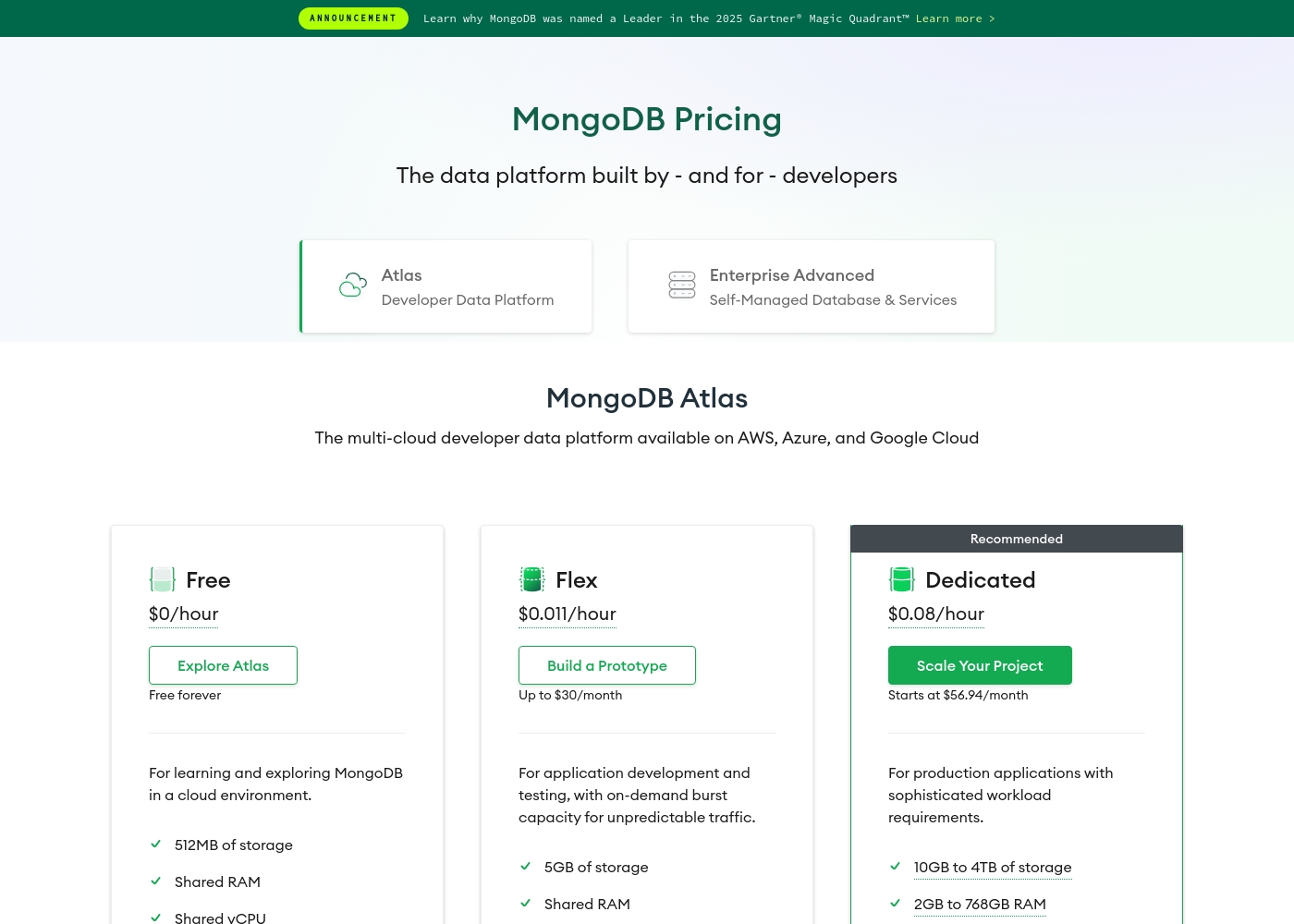
MongoDB pricing: MongoDB offers a range of cloud database options starting with a free-forever tier and scaling to dedicated resources for production environments. Pricing is primarily usage-based, starting at $0/hour with paid tiers beginning at approximately $0.011/hour and $0.08/hour for advanced workloads.
Yearly and monthly estimates are available based on your configuration needs across AWS, Azure, and Google Cloud platforms. Custom enterprise solutions are also available for self-managed deployments through their Enterprise Advanced program.
Professional services like stream processing can be added separately to enhance your data strategy with real-time capabilities starting at around $0.06/hour per instance level SP2 or higher depending on your needs. Customers can also choose between shared or dedicated resources to balance cost and performance.
Pricing Notes
- Google Cloud offers $300 in free credits for new customers, while MongoDB has a free-forever tier.
- Google Cloud's technical support is extremely expensive, costing up to $12,500 per month.
- MongoDB's costs scale with cluster resources (storage, RAM, vCPUs), which can escalate quickly.
- Both platforms use usage-based pricing, making it hard to predict costs without careful monitoring.
- Google Cloud provides committed use discounts up to 57% for predictable workloads.
Pricing Head-to-Head
Nutzerbewertungen
Die externe Stimmung, hauptsächlich erfasst durch Trustpilot, ist überwiegend negativ, was zu einer sehr schlechten Bewertung von 1,5 Sternen führt. Die am häufigsten genannten Probleme sind intransparente Abrechnung und absolut dysfunktionaler Kundensupport ⚠️. Nutzer berichten von unerwarteten Gebühren, die manchmal Hunderte von Dollar betragen, selbst wenn sie über beträchtliche kostenlose Guthaben verfügen. Viele empfinden diesen Mangel an Transparenz als eine „bewusste Falle“ für neue Nutzer. Darüber hinaus ist die Hilfestellung fast unmöglich zu erhalten; Nutzer beschreiben den Support als absichtlich versteckt und unerreichbar, wodurch sie in frustrierende, endlose Schleifen geraten. Wer technischen Support benötigt, sieht sich mit exorbitanten Gebühren konfrontiert, wobei spezialisierter technischer Support teure Tausende pro Monat kostet.
Über die Kostenkontrolle hinaus kritisieren Nutzer die geringe Benutzerfreundlichkeit. Beschwerden umfassen, dass die Konsole „unbrauchbar langsam“ sei und der Prozess für einfache Aufgaben, wie das Abrufen eines API-Schlüssels, übermäßig viele Klicks erfordert. Nutzer kämpfen auch mit wichtigen Kontoverwaltungsfunktionen, wie dem Löschen aktiver Projekte, die weiterhin Gebühren verursachen, oder der Aktualisierung von Abrechnungsinformationen. Dies deutet stark darauf hin, dass zwar die Plattform technologisch leistungsfähig ist, die umgebende Benutzererfahrung, Verwaltung und finanzielle Kontrolle jedoch erhebliche Mängel aufweisen.
Mein Konto verursachte API-Kosten in Höhe von 327 €, obwohl noch 264 € an kostenlosen Guthaben verfügbar waren, die aber nicht genutzt wurden. Der Support ist komplett versteckt und unmöglich zu erreichen, was wie eine bewusste Falle wirkt. Diese Plattform hat eine extrem intransparente Preisstruktur.
Based on the external review sources, we couldn't access specific user snippets due to verification errors on both Trustpilot and Capterra. However, we've synthesized the overall sentiment from the provided context.
Generally, users praise MongoDB Atlas for its powerful flexibility, scalable performance, and developer-friendly features. Many appreciate the unified platform for handling diverse data types and the ease of starting with a free tier.
MongoDB's flexibility is a game-changer for our agile team. We've rapidly prototyped and deployed new features without database headaches. The scalability gives us peace of mind.
Unser Fazit
This isn't a simple apples-to-apples comparison. Google Cloud is the full cloud platform. MongoDB is the specialized data platform. Google Cloud's superpower is its sheer scale. It offers everything from world-class AI with Vertex AI to massive analytics with BigQuery. It's your partner for the entire infrastructure stack. MongoDB's superpower is data unification. It seamlessly blends operational data, vector search, and streaming into one system. This simplifies building complex, data-rich applications dramatically. The deciding factor is your core need. If you need a comprehensive cloud foundation, Google Cloud is the answer. If your biggest challenge is managing and querying diverse application data, MongoDB is your tool. For a startup building from scratch, Google Cloud provides the full toolkit. For a team trying to make their app's data layer smarter and faster, MongoDB delivers targeted power.
Häufig gestellte Fragen
Which is better for small teams: Google Cloud or MongoDB?
MongoDB often wins for small teams focused on their app's database. Its free-forever tier and focused interface are easier to start with. Google Cloud's $300 credit is generous, but its platform can feel overwhelming.
Does Google Cloud have a database like MongoDB?
Yes, Google Cloud offers Firestore and Cloud Datastore as document databases. They serve similar use cases to MongoDB. However, MongoDB's core platform is built entirely around this document model and its associated features.
Is MongoDB worth the extra cost over Google Cloud?
It's not about extra cost, but about value for your specific need. MongoDB's cost is for a specialized data platform. Google Cloud's costs are for a broad infrastructure suite. If you only need a powerful database, MongoDB's pricing can be more predictable.
Can I use Google Cloud and MongoDB together?
Yes, absolutely. You can run MongoDB Atlas as a managed service on Google Cloud infrastructure. This is a common pattern, combining Google's infrastructure with MongoDB's specialized database.
Which is easier to learn for a developer?
Many developers find MongoDB's document model and query API more intuitive initially. Google Cloud requires learning a vast array of services and concepts. The learning curves serve different goals: app development vs. infrastructure management.
Which platform is better for AI applications?
It depends on the AI task. For training custom models at scale, Google Cloud's Vertex AI is more powerful. For adding semantic search or AI features to an app using your existing data, MongoDB's native vector search is simpler.
Bereit zu wählen?
Beide Tools haben Stärken. Wähle passend zu deinem Bedarf.